Aug 25, 2026
Customer complaints are an important source of information for every business. They help companies understand customer expectations, identify service problems, and discover areas that need improvement. However, when complaints are managed through phone calls, emails, spreadsheets, or paper records, businesses may struggle to track every issue properly.
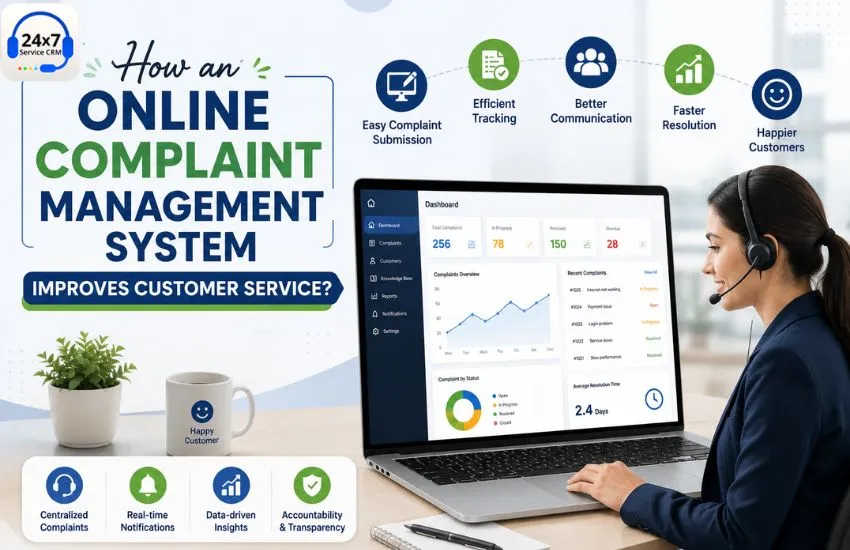
An Online Complaint Management System provides a centralized platform for receiving, assigning, tracking, and resolving customer complaints. By combining complaint management with a Service CRM, businesses can organize customer interactions, improve response times, and provide a more consistent service experience.
An Online Complaint Management System is a digital platform that allows businesses to manage customer complaints from a single location. Customers or service teams can register complaints, while managers can assign them to the appropriate employees and monitor their progress.
Instead of maintaining separate records, businesses can keep complaint details, customer information, communication history, technician assignments, and resolution updates in one system.
This makes complaint handling more structured, transparent, and efficient.
Customers expect businesses to respond quickly when they face a problem. A manual complaint process can sometimes create unnecessary delays.
An Online Complaint Management System makes complaint registration faster. Customer details and issue descriptions can be recorded digitally, allowing service teams to begin working on the complaint without unnecessary paperwork.
Faster registration creates a better first impression and helps businesses respond to customer concerns promptly.
One of the biggest challenges in complaint management is keeping track of multiple open issues.
A centralized system allows managers to see all complaints in one place. They can check which complaints are new, assigned, pending, in progress, or resolved.
This visibility helps prevent complaints from being overlooked and allows management to prioritize urgent issues.
Not every complaint requires the same employee or technician. Some issues may require technical expertise, while others may need customer support assistance.
Complaint management software can help businesses assign complaints to the appropriate team member based on the type of issue, location, priority, or availability.
This can reduce delays and ensure that complaints reach the right person more efficiently.
Response time has a direct impact on customer satisfaction. Customers are more likely to trust a company when their complaints are acknowledged and handled quickly.
An Online Complaint Management System can provide notifications and reminders for pending complaints. Service teams can monitor approaching deadlines and take action before issues remain unresolved for too long.
A structured workflow helps businesses create more consistent response times.
A Service CRM can connect complaint records with customer profiles. This means service teams can view previous complaints, service requests, communication details, and other relevant information.
For example, if a customer reports the same problem multiple times, the service team can review previous records before deciding on the next action.
Having access to historical information can help businesses provide more personalized and effective support.
Poor communication is a common reason for customer dissatisfaction. Even when a company is working on a problem, customers may become frustrated if they do not receive updates.
An online complaint system can help businesses maintain better communication throughout the complaint lifecycle. Teams can record updates, remarks, follow-ups, and resolution details in one place.
Customers can then receive clearer information about the progress of their complaints.
The urgency of each issue varies. A minor request may not require the same immediate attention as a critical service failure.
Complaint management software can allow businesses to categorize complaints according to priority. High-priority issues can be highlighted so that service teams can address them quickly.
This helps companies use their resources more effectively while maintaining service quality.
When complaints are managed manually, it can be difficult to determine who is responsible for a particular issue.
An Online Complaint Management System can record assignments, status changes, follow-ups, and resolution activities. Managers can therefore identify which team member is handling each complaint and monitor its progress.
This creates greater accountability and encourages employees to complete assigned tasks within the expected timeframe.
Some customer complaints cannot be resolved at the first level of support. They may require escalation to a senior technician, manager, or specialized department.
A digital complaint management system can support escalation workflows. If a complaint remains unresolved or exceeds a defined time period, it can be forwarded to the appropriate authority.
This reduces the chances of important complaints remaining unattended.
Businesses need accurate information to understand how effectively they are handling complaints.
An Online Complaint Management System can generate reports related to:
These reports help management identify recurring issues and make informed operational decisions.
Repeated complaints often indicate an underlying business or product issue.
For example, if several customers report the same equipment problem, management can investigate the root cause rather than treating each complaint as an isolated case.
A Service CRM makes it easier to analyze complaint patterns and identify recurring issues. Businesses can then take corrective action to reduce future complaints.
The ultimate goal of complaint management is not simply to close tickets. It is to resolve customer problems effectively and build trust.
When customers receive quick responses, regular updates, and proper solutions, their overall experience can improve.
An Online Complaint Management Software helps businesses create a structured complaint resolution process, which can contribute to stronger customer relationships and improved satisfaction.
A reliable complaint management platform may include features such as:
When these features are integrated with a Service CRM, businesses can manage customer service and complaint resolution from a centralized platform.
A standalone complaint system can help businesses track issues, but integrating it with a Service CRM provides a broader view of customer relationships.
Complaint Management Software Service CRM can connect complaints with customer profiles, service contracts, previous service visits, invoices, technicians, and communication records.
This creates a complete service history that employees can access when handling customer requests.
For service-based businesses, this integration can be particularly useful because many complaints are directly connected to installations, repairs, maintenance, or service appointments.
Customer complaints should not be treated only as problems. They can provide valuable insights into customer expectations and business performance. However, managing complaints effectively requires a structured and transparent process.
An Online Complaint Management System helps businesses register, assign, track, escalate, and resolve complaints more efficiently. When combined with a Service CRM, it can provide complete customer information, improve communication, increase accountability, and support better decision-making.
For businesses handling a growing number of customer complaints, moving from manual processes to digital complaint management can make service operations more organized and responsive. A well-managed complaint process not only helps resolve individual issues but can also contribute to stronger customer relationships and long-term business growth.










Instant free download from Play Store and Apple. Service CRM is one the best Software or Application for field service management. You can book a demo Online.