Sep 18, 2026
Managing an air compressor service business requires more than technical expertise. Service companies need to coordinate field technicians, schedule maintenance visits, manage customer complaints, track equipment, monitor service contracts, and maintain accurate service records. When these activities are handled manually through spreadsheets, phone calls, and paperwork, managing growing service operations can become challenging.
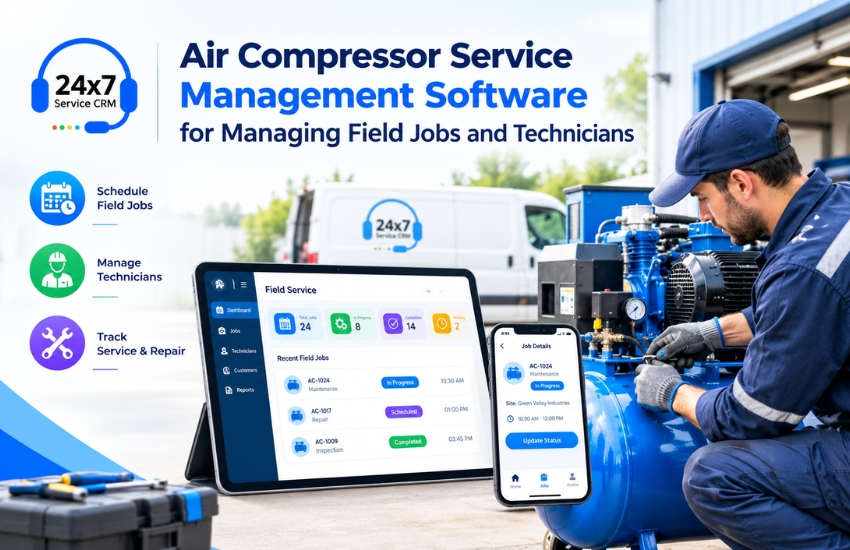
Air Compressor Service Management Software provides a centralized digital solution for managing service requests, field jobs, technicians, customers, equipment, and maintenance activities. It helps air compressor dealers, distributors, service providers, and maintenance companies organize their daily operations and improve visibility across their field service teams.
With the right Air Compressor Business Management Software, businesses can streamline service workflows, reduce manual administrative work, and provide more organized customer support. Adding Service CRM capabilities can further connect customer management with field service operations.
Air Compressor Service Management Software is a specialized business solution designed to help air compressor service companies manage their complete service workflow.
From receiving a customer complaint to assigning a technician and completing the job, the software provides a structured process for managing service activities.
Depending on the solution, businesses can manage:
By keeping this information in one centralized platform, service managers can monitor ongoing work and access important information whenever required.
Air compressor service companies often manage multiple customers and machines across different locations. Technicians may need to visit customer sites for installation, breakdown repair, preventive maintenance, inspections, or replacement of parts.
Managing these activities manually can result in common challenges such as missed service requests, delayed technician assignments, duplicate data, incomplete service records, and poor communication.
Air Compressor Business Management Software helps create a standardized workflow for these activities.
Instead of depending on separate spreadsheets and communication channels, businesses can manage customer requests, field jobs, technicians, and service records through a centralized system.
Customer information is an important part of every service business. Service software can maintain customer names, contact details, locations, equipment information, service contracts, and previous service records.
With Service CRM functionality, employees can quickly access customer information when handling a new service request.
This helps support teams understand the customer's requirements and previous service history before assigning or processing a job.
Customers may contact an air compressor company for breakdowns, maintenance, inspections, installations, or technical support.
The software can record each request as a service ticket or job. Managers can assign priorities, add technical details, upload documents, and track the status from creation to completion.
This provides better visibility into pending, ongoing, and completed service requests.
Assigning the right technician to the right job is essential for efficient field service operations.
Air Compressor Service Management Software can help managers allocate jobs based on technician availability, location, workload, or technical expertise.
Technicians can receive job details and customer information, helping them prepare before visiting the customer site.
Managing multiple field visits can be complicated when appointments are tracked manually.
A centralized scheduling system helps managers organize technician calendars, service appointments, pending jobs, and planned maintenance visits.
This can reduce scheduling conflicts and provide a clearer overview of daily field operations.
Air compressor service businesses often maintain multiple machines for each customer.
Software can store important equipment information such as machine model, serial number, installation date, warranty information, maintenance records, and service history.
When a customer raises a complaint, technicians can review the machine's previous service records before beginning troubleshooting.
Preventive maintenance helps businesses schedule regular service activities before equipment problems occur.
Air Compressor Business Management Software can help service companies create maintenance schedules and track upcoming preventive maintenance jobs.
Managers can monitor which machines require servicing and assign technicians accordingly.
This creates a more systematic approach to recurring maintenance work.
Annual Maintenance Contracts (AMCs) are an important part of many air compressor service businesses.
All in one AMC Management Software can help businesses maintain contract information, customer details, contract periods, covered equipment, and scheduled service visits.
Automated reminders can help service teams identify upcoming maintenance activities and contract renewals.
After completing a field visit, technicians need to record the work performed.
Digital service reports allow technicians to enter job details, observations, parts used, recommendations, and customer remarks.
Depending on the software, technicians may also capture customer signatures, photographs, readings, and other relevant information.
Digital records make service documentation easier to access and reduce dependency on physical paperwork.
Managers can monitor service requests, technician assignments, appointments, and job status from a centralized dashboard.
This improves coordination between office staff and field technicians.
Automating repetitive activities such as ticket creation, assignment, reminders, scheduling, and reporting can reduce administrative effort.
Employees can dedicate more time to delivering excellent customer service and managing core business operations.
When service requests are recorded and assigned systematically, teams can identify pending jobs more quickly.
Technicians receive relevant information before visiting the customer, which can support faster and more organized service delivery.
Customers want to know when their technician will arrive and what is happening with their service request.
Service CRM can support timely communication through notifications and status updates, helping customers stay informed.
A centralized service history allows businesses to review previous breakdowns, maintenance visits, repairs, parts replacements, and technician notes.
This information can be useful when diagnosing recurring equipment issues and planning future maintenance.
Managers can monitor assigned jobs, completed work, pending tasks, and technician workloads.
This visibility helps businesses understand how field resources are being utilized and where operational improvements may be required.
A traditional service management system may focus mainly on field jobs and technician activities. Service CRM extends this functionality by connecting service operations with customer relationship management.
For an air compressor company, this can mean maintaining customer records, equipment information, service history, AMC details, quotations, follow-ups, and field jobs in one system.
Sales and service teams can also have better access to customer information, reducing communication gaps between departments.
For businesses that manage both sales and after-sales service, combining CRM and service management capabilities can create a more connected workflow.
Before selecting software, businesses should evaluate their specific service requirements.
Important features to consider include:
The software should be flexible enough to support current operations while allowing the business to expand its customer base and technician network.
Air Compressor Service Management Software can help service businesses organize field jobs, technicians, customer requests, equipment records, maintenance schedules, and service documentation from a centralized platform.
With Air Compressor Business Management Software, companies can reduce manual processes, improve field service coordination, monitor technician activities, and maintain better visibility into daily operations.
Adding Service CRM capabilities further connects customer management with service operations, allowing businesses to maintain customer information, equipment history, AMC details, service records, and follow-ups in one place.
For growing air compressor dealers and service companies, adopting a centralized service management solution can create a more organized workflow and provide a scalable foundation for managing field service operations and customer relationships.









Instant free download from Play Store and Apple. Service CRM is one the best Software or Application for field service management. You can book a demo Online.